AI-Guided Protein Design · Campaign Foundations
A Wet-Lab Scientist's Guide to AI-Enabled Protein Design
How modern protein-design campaigns move from biological objectives and generative models to experimentally actionable candidate shortlists.
Generative protein-design tools can produce convincing structures in minutes. The harder problem is deciding what to design, which outputs are credible, how candidates should be compared, and which molecules are worth carrying into the laboratory.
This guide approaches AI-enabled protein design as a campaign rather than a sequence of software tools. It focuses on the decisions that connect biological intent to molecular design: defining the product profile, selecting a target and modality, constructing a screening funnel, managing model handoffs, and deciding when computational evidence is strong enough to justify experimental work.
The first three pages establish principles that apply broadly across protein-engineering programs. They describe how campaigns are organized, how computational and experimental stages fit within a Design-Build-Test-Learn cycle, and how increasingly expensive analyses should be allocated across a narrowing candidate pool.
The later volumes apply this framework to specific design problems. Volume 1 follows a de novo mini-protein binder campaign against PD-L1. Volume 2 extends the same campaign logic to scaffold-constrained VHH design. The molecular systems differ, but the underlying questions remain the same: What should be generated? What should be filtered out? Which evidence is genuinely independent? And what should be tested next?
Protein engineering campaigns run on DBTL cycles
Protein engineering is the deliberate modification or creation of proteins to achieve a useful function. A campaign may begin with an existing natural protein that needs to be improved, a known scaffold that can be retargeted, or a desired function with no starting molecule at all.
The goal is rarely to optimize a single property. A successful molecule must usually balance activity or binding with specificity, stability, expression, solubility, and manufacturability. Protein engineering is therefore a structured search through a large design space for molecules that satisfy several competing requirements at once.
A campaign coordinates repeated rounds of design, construction, testing, and analysis to develop a molecule against a defined performance specification. Unlike a single experiment, a campaign has explicit budgets, timelines, decision gates, and stopping criteria. The organizing principle is the Design-Build-Test-Learn cycle:
🔵 Design
Propose candidate molecules using computational methods. This portfolio examines the computational Design phase in depth.
🟢 Build
Synthesize DNA, express protein, and purify candidates. Many designs fail here. The build phase is a filter, not merely manufacturing.
🟡 Test
Run binding, stability, and functional assays. Each assay should answer a defined question using appropriate controls.
🟣 Learn
Analyze outcomes and feed structured results into the next round. This is often the least developed phase of a campaign.
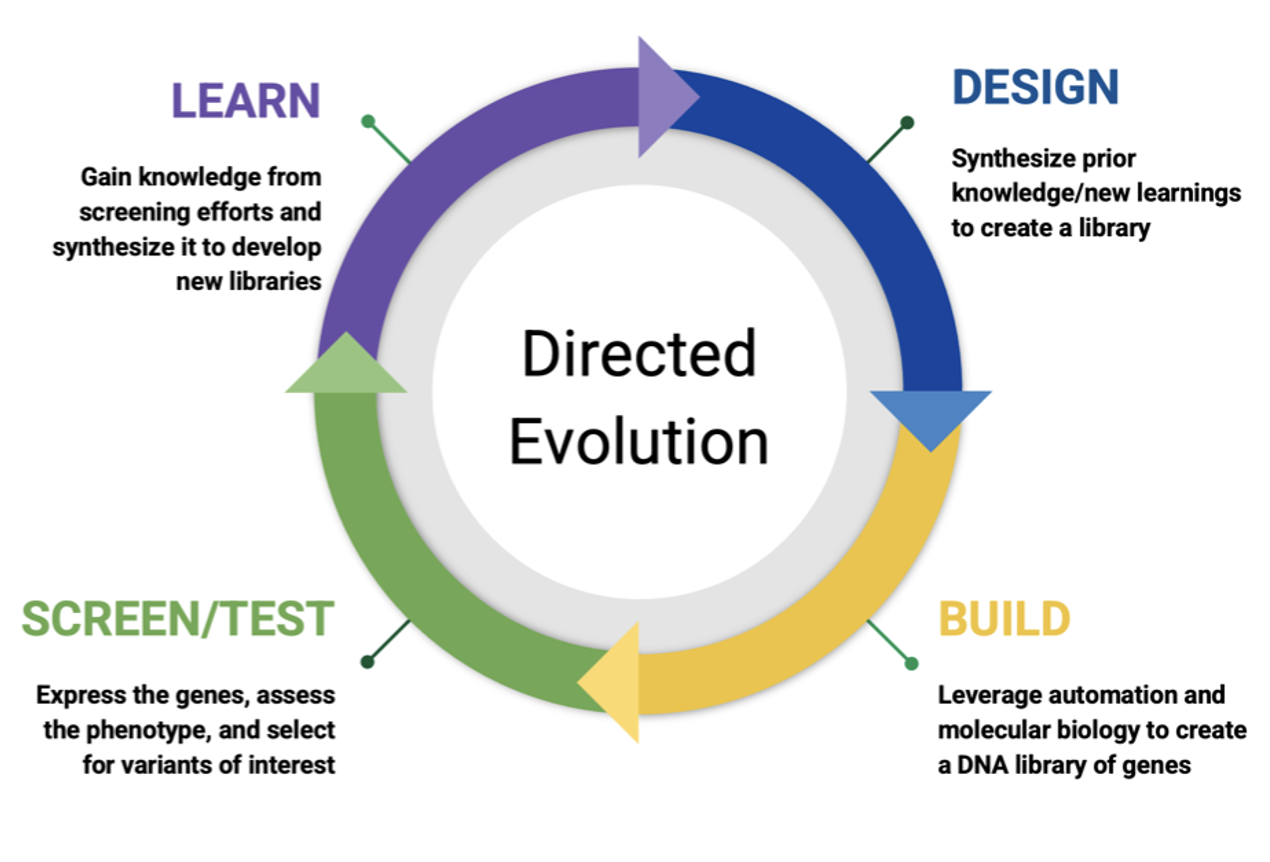
Figure 1. The DBTL cycle. Each round passes through all four phases, with structured outcomes from the Learn phase informing the next Design round. The campaign-foundation pages explain how computational design fits within this broader experimental cycle; the later volumes apply those principles to specific molecular-design problems.
In an academic study, a successful protein design may be treated as the endpoint. In a campaign, the result of Round 1 is the input to Round 2. Designs that fail can be as informative as those that succeed, but only when sequences, design conditions, assay results, and failure modes are captured systematically. Structured failure analysis is part of the campaign, not an afterthought.
Campaign foundations
These three foundation pages establish the concepts used throughout the portfolio. They cover how protein-engineering campaigns are structured, how targets and modalities are selected, how candidate funnels allocate computational and experimental effort, and how model outputs should be integrated without treating any single prediction as definitive.
Case study: Volume 1 — De Novo Mini-Binder Design
With the campaign framework established, Volume 1 applies it to the design of de novo mini-protein binders against PD-L1. The detailed pages follow the campaign from candidate generation through progressively more selective layers of structural, interface, and physical assessment.
The working codebase behind the first case study
The campaign principles introduced above are applied in Volume 1 to de novo mini-protein binder design against PD-L1. The accompanying guide provides the working codebase for that case study: cleaned and annotated Colab notebooks, helper scripts, example inputs and outputs, troubleshooting notes, and a consistent data structure connecting each computational stage.
What you get
Who this is for
Scientists who want to apply existing protein-design models and translate their outputs into experimental decisions. The guide teaches campaign execution and scientific judgment rather than neural-network architecture or model training. It is particularly useful for researchers moving into computational design from a wet-lab background.
The individual tools used in this workflow are publicly available. The guide provides the integration layer: a tested and consistent route from target preparation to candidate prioritization, so that time can be spent interpreting the science rather than debugging file paths and model handoffs.